
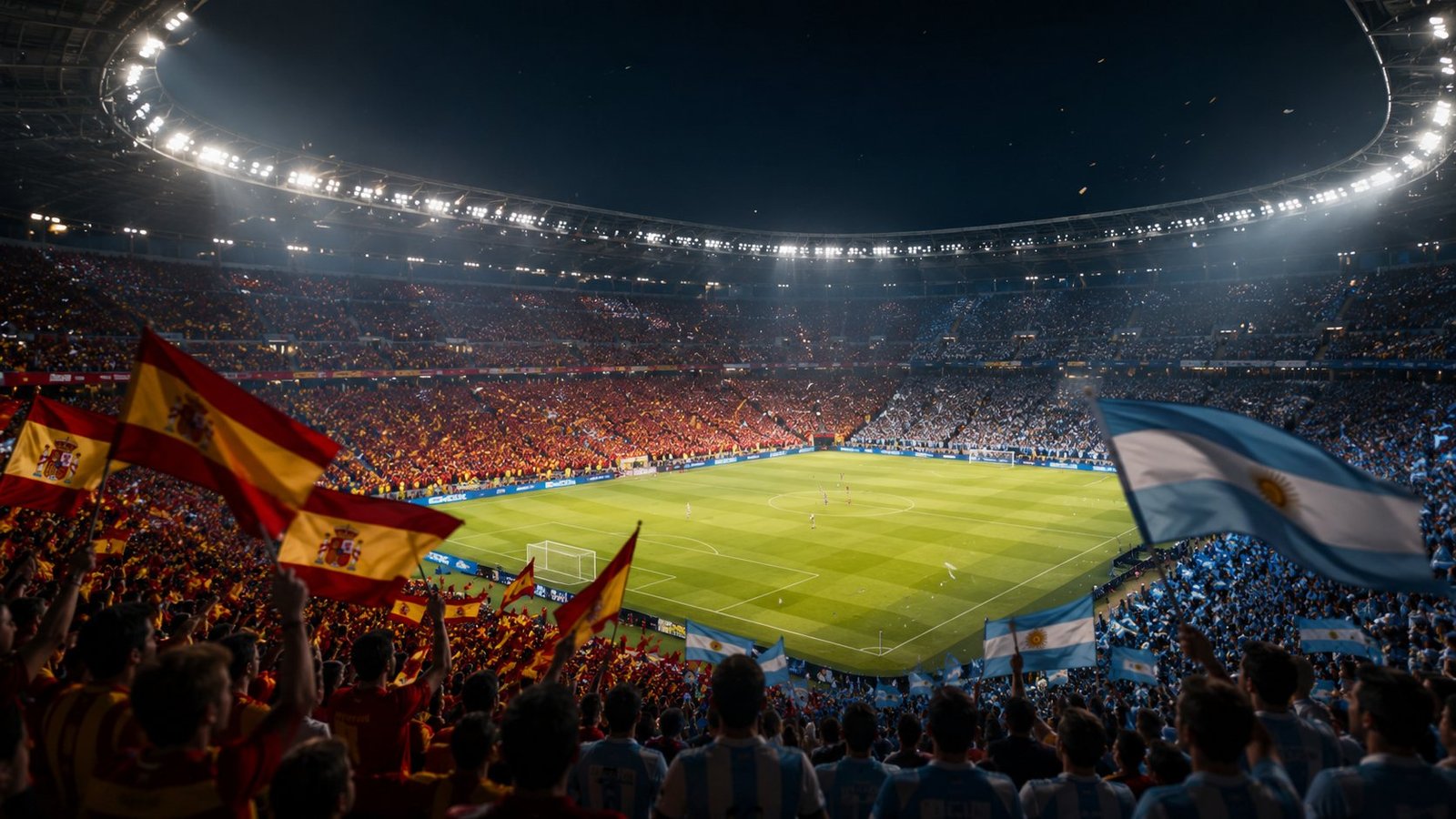
Spain will face Argentina in the 2026 FIFA World Cup final. Spain reached the final by defeating France 2-0, while Argentina beat England 2-1 in the other semi-final. Spain enter the final unbeaten with 6 wins, 1 draw, 13 goals scored and only 1 conceded. Argentina arrive with a perfect record of 7 wins, 19 goals scored and 7 conceded. The final will be played at New York New Jersey Stadium on Sunday, July 19 local time. In Spain, the match kicks off at 9:00 p.m. on July 19. In Korea, it starts at 4:00 a.m. on Monday, July 20.
Spain and Argentina will meet in the 2026 FIFA World Cup final.
FIFA, the Fédération Internationale de Football Association, is the international governing body responsible for organising the World Cup and maintaining the tournament’s official fixtures, results and competition records.
Spain reached the final by defeating France 2-0 in the semi-final. Argentina secured their place with a 2-1 comeback win over England.
The final will be played at New York New Jersey Stadium on Sunday, July 19, at 3 p.m. local time on the U.S. East Coast. The match will kick off at 9 p.m. in Spain and at 4 a.m. on Monday, July 20, in Korea.
France will face England in the third-place match. That game is scheduled for Saturday, July 18, at Miami Stadium.
Spain beat France 2-0
Spain advanced to the final with a controlled 2-0 win over France.
Mikel Oyarzabal opened the scoring from the penalty spot in the 22nd minute. Pedro Porro added the second goal in the 58th minute.
Spain did not simply keep possession for the sake of possession. The team used the ball to slow France’s transitions, control the pace of the match and prevent France’s attacking players from finding space.
France tried to attack through speed and wide areas, but Spain kept compact distances between midfield and defence.
Porro’s goal was also important because it showed how Spain use their full-backs in attack. He combined with Dani Olmo, moved into the penalty area and finished the chance himself.
Spain’s full-backs are not only defensive players. In possession, they become part of the attacking structure, helping create width, overloads and passing options.
Argentina beat England 2-1
Argentina reached the final after a late comeback against England.
England took the lead in the 55th minute through Anthony Gordon. Argentina equalised in the 85th minute through Enzo Fernández, before Lautaro Martínez scored the winner in stoppage time.
Lionel Messi was involved in both late goals, helping Argentina overturn the match and return to the World Cup final.
For Spain, Argentina’s late-game strength will be one of the biggest concerns. Argentina have shown that they can keep pressure on an opponent until the final minutes.
Spain’s road to the final
Spain began the tournament with a 0-0 draw against Cape Verde. They then defeated Saudi Arabia 4-0 and Uruguay 1-0 to finish the group stage with two wins and one draw.
Since the start of the knockout stage, Spain have won four consecutive matches.
They beat Austria 3-0 in the Round of 32, Portugal 1-0 in the Round of 16, Belgium 2-1 in the quarter-final and France 2-0 in the semi-final.
Spain’s overall record before the final is six wins and one draw. They have scored 13 goals and conceded only one.
The only goal conceded by Spain came against Belgium in the quarter-final.
This record highlights Spain’s balance. The team is built around possession and technical control, but its defensive structure has also been one of the strongest features of the tournament.
Argentina’s road to the final
Argentina have won all seven of their matches.
In the group stage, they defeated Algeria 3-0, Austria 2-0 and Jordan 3-1.
In the knockout stage, they beat Cape Verde 3-2, Egypt 3-2, Switzerland 3-1 and England 2-1.
Argentina have scored 19 goals and conceded seven.
If Spain enter the final as the tournament’s most secure defensive team, Argentina arrive as the strongest attacking side. The final can be understood as a meeting between Spain’s control and Argentina’s finishing power.
Lamine Yamal and Lionel Messi
One of the main storylines of the final is the contrast between Lamine Yamal and Lionel Messi.
Yamal has become one of Spain’s most important attacking players. He gives Spain width on the right side, forces defenders to adjust their positions and creates space between the wing and central areas.
Against France, Yamal won the penalty that led to Spain’s opening goal.
Messi remains central to Argentina’s attacking structure. Against England, he was involved in the key moments that turned the semi-final around.
Yamal represents the present and future of Spanish football. Messi represents Argentina’s experience, history and ability to decide matches at the highest level.
The final should not be reduced to a single individual duel, but the influence of both players will be important.
Spain’s key tasks in the final
Spain’s first task will be to control midfield.
Against France, Spain controlled the rhythm of the match and reduced the impact of France’s attacking speed. Against Argentina, they will need to manage possession without allowing dangerous central turnovers.
Argentina can escape pressure through short combinations and quickly move the ball into advanced areas. Spain must keep their midfield compact and ready to press immediately after losing possession.
The second task will be concentration in the final stages of the match.
Argentina scored twice late against England. Spain cannot assume that a lead will be safe until the final whistle.
The third task will be defending set pieces and the penalty area.
World Cup finals often produce few clear chances. A corner, free kick, second ball or defensive error can decide the match.
The fourth task will be attacking efficiency from wide areas.
Spain can use Yamal, the opposite winger and advancing full-backs to stretch Argentina’s defensive structure. But the higher Spain’s full-backs move, the more space may appear behind them.
The balance between attacking width and defensive transition will be crucial.
Final outlook
Spain cannot rely on possession alone.
Argentina are capable of changing a match through one transition, one pass from Messi or one decisive finish in the box.
Spain must turn possession into real chances. Movements into the penalty area, quick switches of play and combinations between the wide players and midfielders will be important.
Argentina’s main threat will come from Messi’s passing, Martínez’s movement and the timing of midfield runners around the penalty area.
Spain must protect the space between central defence and defensive midfield. If Argentina find that zone, they can create high-quality chances quickly.
Fitness may also become a factor.
Spain completed the semi-final against France in 90 minutes. Argentina had to maintain high intensity until the final moments against England. Recovery, substitutions and the possibility of extra time may influence the final.
Spain chase a second World Cup title
Spain are one win away from their second World Cup title.
Their first came in 2010, when they defeated the Netherlands in South Africa.
Argentina are chasing back-to-back World Cup titles after winning in 2022. If they succeed, they would become the first team since Brazil in 1958 and 1962 to win consecutive World Cups.
This final also brings together the current European champions and the defending South American and world champions.
Spain have conceded only once in the tournament. Argentina have scored 19 goals.
The final is therefore a direct meeting between Spain’s defensive balance and Argentina’s attacking power.
If Spain reproduce the midfield control, defensive concentration and wide attacking structure shown against France, they will have a strong chance of winning the title.
But Argentina have won every match in the tournament and have already shown their ability to change games late.
The 2026 World Cup final will decide whether Spain can return to the top of world football or whether Argentina can extend its era with another global title.